
Gujarat National Law University (GNLU) launches Report on ‘Crypto-Assets in India: Assessing the Case for Regulation’
#New GNLU–SILF report on crypto assets outlines regulatory models for Crypto Assets in India
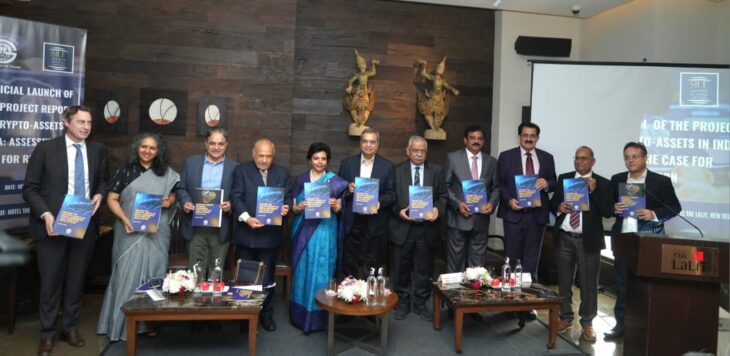
The Gujarat National Law University (GNLU), in partnership with the Society of Indian Law Firms (SILF), on Tuesday formally launched its project report titled “Crypto-Assets in India: Assessing the Case for Regulation” at an event held at The Lalit, New Delhi. The report presents a comprehensive examination of India’s current approach to crypto-assets and outlines a structured framework for regulation aimed at balancing innovation, investor protection and financial stability.
The report underscores that India is at a critical juncture in shaping its regulatory architecture for digital assets. While the government has introduced certain fiscal and compliance measures in recent years—such as the taxation of virtual digital assets and the extension of anti-money laundering obligations to crypto intermediaries—the absence of a dedicated statutory framework continues to create regulatory ambiguity for market participants. The study argues that a coherent and forward-looking regulatory regime is essential to ensure that India remains competitive in the rapidly evolving global Web3 ecosystem. The report puts forth various models of regulation by different existing regulators, along with a new model of self regulation under government oversight till the time a robust regulatory ecosystem is established.
The launch event brought together senior members of the judiciary, leading legal practitioners, policy experts and representatives from the digital asset industry to deliberate on the future trajectory of crypto regulation in India.
The event was attended by Justice Hima Kohli, Former Judge of the Supreme Court of India, who shared her views on the evolving legal and regulatory landscape surrounding digital assets. Other distinguished speakers at the event included Justice M. R. Shah, Former Judge of the Supreme Court of India; Justice Ravi Tripathi, Former Judge of the Gujarat High Court; Dr. Lalit Bhasin, President of the Society of Indian Law Firms (SILF); and Prof. (Dr.) S. Shanthakumar, Director of Gujarat National Law University.
Justice Hima Kohli, Former Judge, Supreme Court of India, said, “Crypto assets illustrate the broader challenge that legal systems face when technological innovation evolves faster than legislative processes. Today, with the global crypto market exceeding $2.4 trillion and India emerging as one of the largest markets with millions of users, the policy debate is no longer about whether such technologies should exist but about how they should be regulated. The task before policymakers is to craft a balanced framework that protects financial stability, ensures investor protection and transparency, while allowing innovation in blockchain and digital technologies to continue.”
Justice M. R. Shah, Former Judge, Supreme Court of India, said, “With nearly 12 crore Indians already investing in crypto assets, it is no longer possible to simply ignore this sector. In a globalised digital economy, attempts to stop such technologies are neither practical nor effective. The real need is for a clear regulatory framework that ensures transparency, prevents misuse and protects the interests of investors. The government’s decision to tax income from virtual digital assets is an important first step, but comprehensive regulation will be essential to strengthen confidence in this emerging ecosystem.”
Justice Ravi Tripathi, Former Judge, Gujarat High Court, said, “In an era where technology is rapidly transforming society and the economy, institutions cannot afford to ignore emerging developments such as crypto assets. Academic institutions have an important role to play in studying such complex issues and contributing thoughtful recommendations to policymakers. Initiatives like this report demonstrate how research and informed dialogue can help shape regulatory thinking on technologies that already exist and are increasingly influencing economic activity.”
Prof. (Dr.) S. Shanthakumar, Director, Gujarat National Law University, said, “What began as a classroom discussion on a regulatory grey area eventually evolved into a national research initiative. With nearly 12 crore Indians engaging with crypto assets despite the absence of a comprehensive regulatory framework, we felt it was important for academia to contribute to the policy conversation. Through stakeholder consultations in Bengaluru, Mumbai and Delhi involving developers, exchanges, regulators and legal experts, the university sought to understand the technology and its challenges. The report ultimately presents five possible regulatory models, leaving policymakers with practical options to consider while shaping India’s approach to crypto regulation.”
Drawing on comparative regulatory models and global policy developments, the report highlights that several major economies have moved toward clear regulatory frameworks for crypto-assets. It notes that the absence of a comprehensive domestic framework in India has contributed to regulatory uncertainty, with implications for capital flows, industry development and technological innovation.
The report calls for a calibrated regulatory approach that combines institutional oversight with coordinated participation from relevant regulators. It recommends a framework that strengthens consumer protection, addresses risks relating to financial stability and illicit finance, and simultaneously supports the development of blockchain-based innovation within India.
The project was guided by an eminent advisory board comprising Justice M. R. Shah, Former Judge of the Supreme Court of India; Justice Ravi Tripathi, Former Judge of the Gujarat High Court; Rajkumar, Former Chief Secretary, Government of Gujarat; J. P. Gupta, Former Additional Chief Secretary, Government of Gujarat; Dr. Keshav Kumar, Former DGP and Director, Anti-Corruption Bureau; Senior Advocate N. S. Nappinai; Prof. Vijaya Bhaskar Marisetty, Dr. B. R. Ambedkar Chair Professor at IIM Visakhapatnam; Prof. M. K. Bhandari, Founder, ILTES and expert in Blockchain, AI, FinTech and Law; Chittu Nagarajan, Online Dispute Resolution expert; Advocate Mitali Gupta; Kalyanjit Hatibarua, Managing Director, Flugelsoft Group of Companies; and actor Kabir Bedi.