
Indian Scientists have conducted an unprecedented archaeological study on Majuli Island
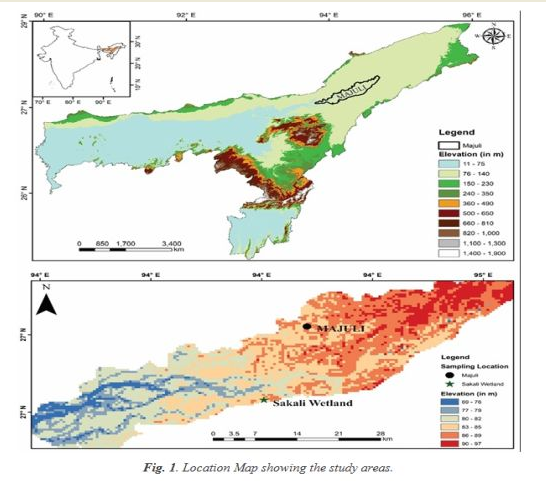
Researchers from the Birbal Sahni Institute of Palaeosciences analysed a 150-cm sediment core collected from the Sakali Wetland on the island. By combining fossil pollen analysis with grain-size studies, they produced the first comprehensive environmental record of Majuli’s climate, vegetation and river dynamics spanning the last four millennia.
The study found that between about 4,040 and 2,260 years before present, the region experienced warm and humid conditions with dense forest cover, demonstrating resilience even during the global 4.2-kiloyear climatic event. Subsequent periods witnessed fluctuations in monsoon intensity and flood regimes, including a wetter phase corresponding to the Medieval Climatic Anomaly.
Evidence from the last 500 years points to declining temperatures and precipitation associated with the Little Ice Age, alongside increasing human influence on the landscape and the expansion of scattered vegetation.
The grain-size analysis also revealed a transition from relatively low-energy to high-energy river conditions, indicating growing hydrodynamic instability in the Brahmaputra river system. The findings improve understanding of long-term flood intensity, sediment transport and erosion processes that continue to affect Majuli.
Published in the journal Review of Palaeobotany and Palynology, the study highlights how climate, vegetation and river processes have interacted over centuries. Researchers say the findings can support biodiversity conservation, wetland restoration, disaster mitigation and climate-resilient planning for communities facing recurrent floods and land loss in the Brahmaputra basin.